← All products · Step 1 · Program

CTE Scaler
Cuts the part the size it has to be in your shop, so it measures nominal at 68 °F.
▶ The 66-second overview · captions, so it works with the sound off
← All products · Step 1 · Program
Cuts the part the size it has to be in your shop, so it measures nominal at 68 °F.
▶ The 66-second overview · captions, so it works with the sound off
CTE Scaler
Correcting an inspection report tells you what the part would have measured at 68 °F. CTE Scaler goes the other way and puts the difference into the geometry before the first chip — so the part comes off the machine at the size your shop needs it to be, and lands on nominal once it settles at the reference temperature.
The scale goes onto a marked manufacturing copy of the model. Your master is never touched, so the CMM and the print keep the original. The copy is scaled about the setup’s own work origin — not the design origin, which would shift every datum — and the toolpaths are regenerated against it.
The direction is the part everybody gets backwards, so the app states it in plain language before it does anything: a shop above 68 °F makes the copy larger, and parts cut to it shrink onto nominal as they cool. A shop below 68 °F makes it smaller, and parts grow onto nominal as they warm.
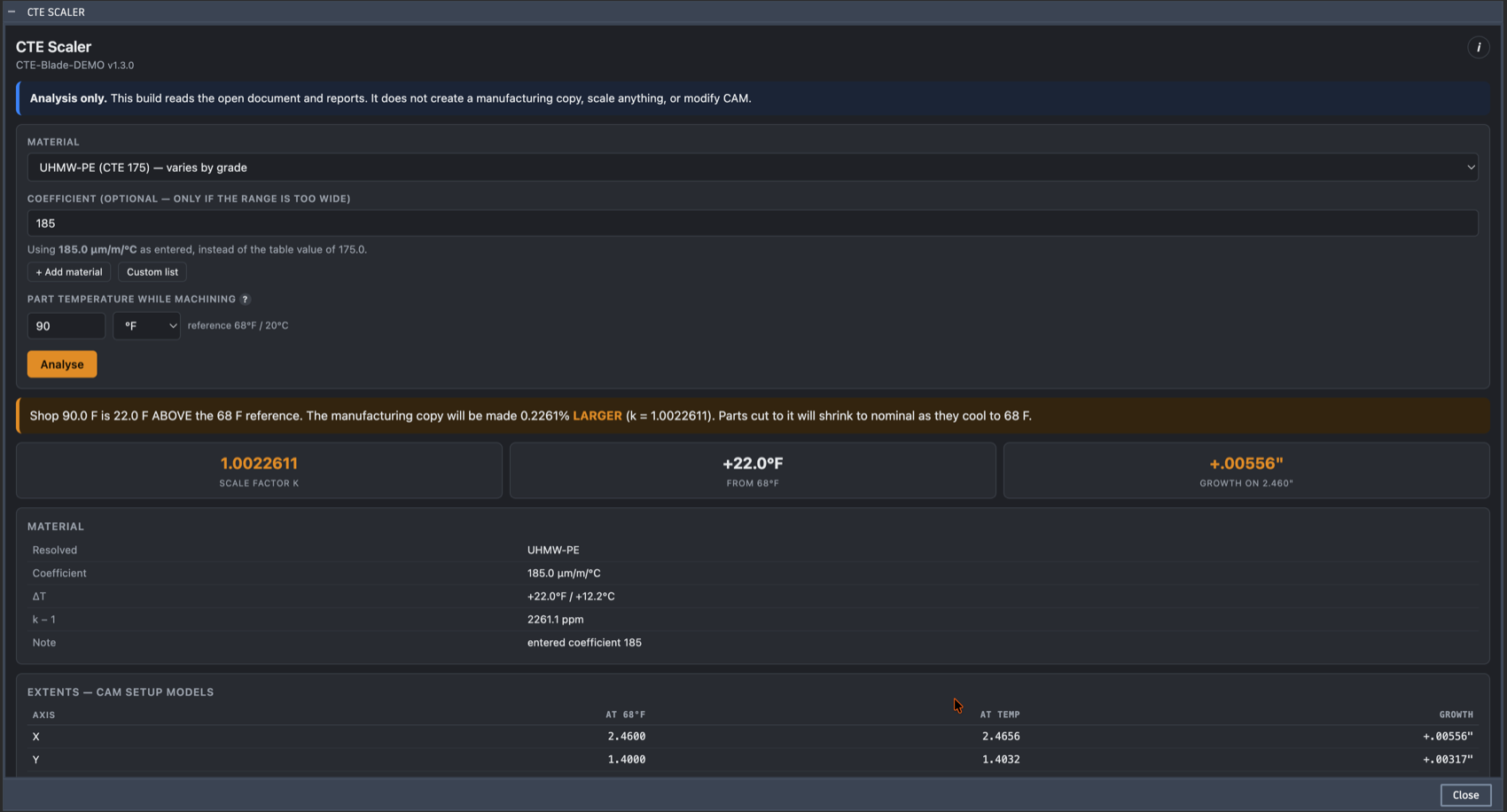
A real run on a demo part. UHMW is a wide material — grades run from roughly 130 to 200 — so the operator typed the grade’s own 185 µm/m/°C instead of accepting the table’s 175, and the app records which number it used and that it was entered by hand. At 90 °F, twenty-two degrees above the reference, that works out to k = 1.0022611: the manufacturing copy is made 0.2261 % larger, and a 2.460 in feature carries +0.00556 in of it. The extents table shows every axis of the CAM setup at 68 °F and at temperature, so the growth is visible per axis before anything is scaled.
This build reports and stops there. It reads the open document, tells you what it would do, and writes nothing — which is also the safest way to try it on your own model.
It cannot be corrected twice
A program posted from a scaled copy already carries shop-temperature nominals, so its deviations are already 68 °F deviations. Correcting them again in the report would subtract the growth a second time — about ten tenths on six inches of aluminum in a 55 °F shop, silently, in the scrap direction. So the post stamps the scale factor into the program, with the material and the temperature it was built for, and Inspection Reporter refuses to apply its own correction when that stamp is present. That is why the scaler, the post processor and the report are versioned as one system.
Get in touch for pricing, a demo, or to talk shop. Built by machinists — happy to talk machinist.
Thanks, we have your request. We will email you to set up a time.